The Legacy of the Crushed 1981 PATCO Strike
Forty years ago today, 13,000 air traffic controllers went on strike. President Ronald Reagan would soon crush that strike — leading to devastating consequences for organized labor and all workers that we’re still dealing with today.
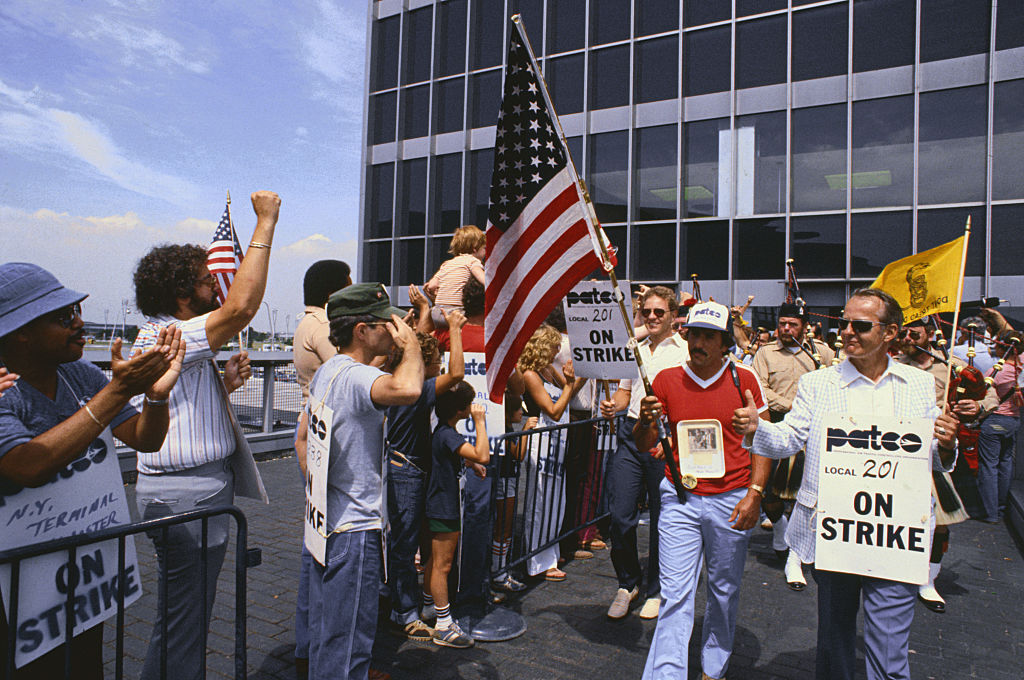
Strikers belonging to the Professional Air Traffic Controllers Organization (PATCO) march at JFK Airport in New York. (Getty Images)
On August 3, 1981, forty years ago today, thirteen thousand members of the Professional Air Traffic Controllers Organization (PATCO) went on strike, demanding an annual wage increase, upgrades to outdated equipment, and a reduced workweek. Two days later, President Ronald Reagan fired 11,345 of them, sending a clear signal to corporate America that it could declare open season on organized labor and US workers generally.
The aggressively anti-union tactics employed by the Reagan administration against PATCO ushered in a renewed era of strikebreaking that’s still with us today, from the failed Detroit newspaper strike of 1995–1997 to Verizon’s hiring of ten thousand nonunion workers in an attempt to break a 2016 strike.
The strike was a consequence of stalled contract negotiations between PATCO and the Federal Aviation Administration (FAA). The controllers called for a reduced workweek, bringing the existing five-day, forty-hour workweek down to four days and thirty-two hours, in response to widespread controller fatigue. The job was inherently stressful — workers regularly developed ulcers and high blood pressure — but that stress was exacerbated in 1978 by airline industry deregulation under President Jimmy Carter.